4 September 2026
The user manual is online — and you don't owe us anything for it
RideComposer's user manual is now public, in seven languages, as a PDF. No account, no email address, no form. Here's why, and how it stays current.
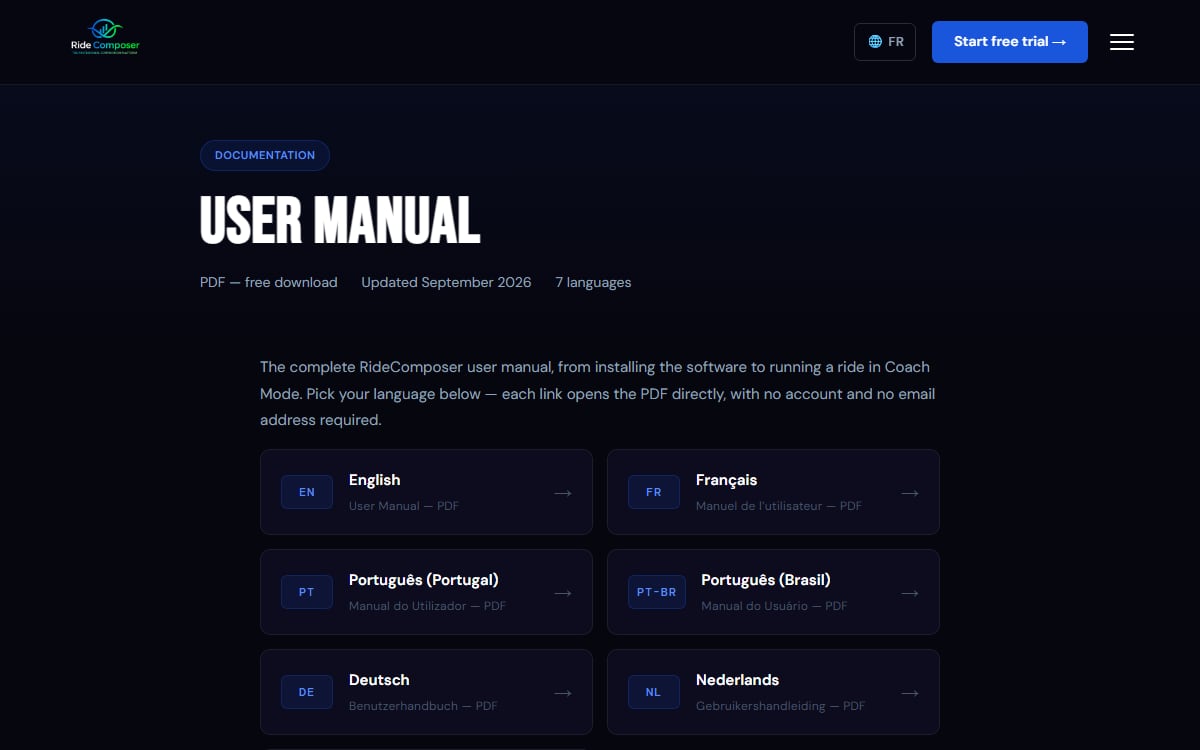
RideComposer's manual has existed for a long time. It travelled by email, sat in a tester's folder, turned up as an attachment when somebody asked for it. Which meant you had to already know it existed before you had any hope of reading it.
That's over. The user manual is now published on the site, freely available:
Seven languages, because you are not one single audience
Update, 5 September 2026 — this article announced four languages and promised Dutch and German. They are here, and Greek came with them. The manual now exists in seven languages.
The manual comes in English, French, Portuguese — in both its variants, Portugal and Brazil —, Dutch, German and Greek. That isn't decoration: those are the languages our users actually write to us in.
An instructor discovering a piece of software shouldn't have to make the extra effort of discovering it in a foreign language.
The three newest manuals are not machine translations dropped next to the English file: the English document itself was translated from the inside, sentence by sentence, keeping its layout, its screenshots and its table of contents. As in the French edition, the interface labels stay in English — that is what you have in front of you in the software, and you have to be able to find it again in the manual.
No account, no email, no form
The link opens the PDF. That's the whole procedure.
We could have done what almost everyone does: ask for your address in exchange, and quietly add you to a mailing list along the way. We chose not to, for a simple reason — documentation you have to trade an email address for isn't quite documentation any more. It's a sales pitch wearing a lab coat.
Want to read how the software works before you even install it? Go ahead. You owe us nothing.
Bookmark the page, not the file
One piece of advice that matters over time.
The manual follows the software's versions: it changes when RideComposer changes. Save the PDF to your disk and you keep a photograph of the software as it was the day you downloaded it — and six months from now, that photograph will describe screens that no longer quite exist.
The page's address, on the other hand, never changes. It always serves the current version. Bookmark the page, open it when a question comes up, and you'll always be reading the manual that matches the software in front of you.
It's in the FAQ too, and Rozália knows about it
Two other routes lead to the manual, for those who won't think of coming through this page.
The site's FAQ now mentions it in the general section. And Rozália, the assistant in the chat bubble at the bottom right of our pages, knows how to find it: just ask her where the manual is, in whichever language suits you.
And if something is missing from it?
The manual is a living document, not a fixed brochure. If it leaves you with an unanswered question, that's useful information for us: write to [email protected].
That's often how a chapter gets written — exactly as one instructor's email triggered, back in August, the complete rebuild of our tempo detection.